
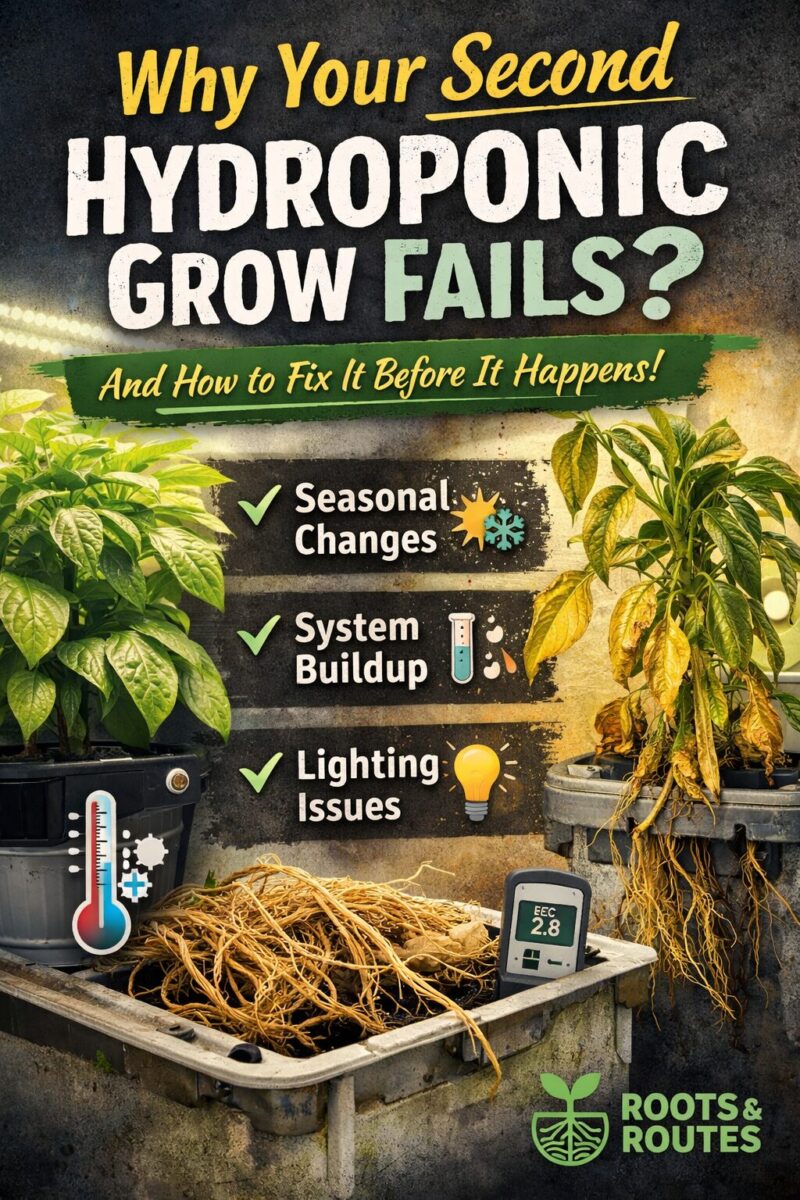
If you’re asking yourself why your second hydroponic grow fails, the short answer is this: even when your equipment stays the same, your environment and system conditions don’t. Small invisible changes — from leftover salt in the system to seasonal swings in humidity — can stress plants in ways you didn’t see the first time around.
Lots of growers report that their first cycle goes great, only for the next one to struggle in ways that don’t seem to add up. This isn’t bad luck — it’s the result of real, measurable changes that affect water quality, root health, nutrient uptake, and plant stress.
In this article I’ll break down the most common reasons second grows go sideways, and I’ll show you how to prevent it before you hit the tent again.
Seasonal Changes Affect Indoor Grows More Than You Realize
One reason your second hydroponic grow can behave very differently is that the “indoor” conditions you think you control aren’t actually static.
Even in a tent with environmental controls, the air your system pulls in comes from your grow room, which is influenced by outdoor temperature and humidity. That matters.
A good example: One grower I know had his first tent run in early spring. Temps were stable, humidity hovered around ideal, and CO₂ stayed consistent. Plants jumped out of the gates. A few months later he attempted a second grow in mid-summer — same nutrients, same strain, same feeding schedule — and the plants slowed down, showed heat stress along the edges of leaves, and never quite looked as happy.
Why? Two subtle but critical changes:
- Summer heat raised reservoir temperatures by a few degrees, reducing dissolved oxygen levels around the roots.
- Humidity dropped as the house AC kicked in, forcing plants to transpire faster than they could comfortably cope with.
These kinds of shifts don’t show up in your notes unless you track them, but they definitely show up in plant performance.
Why this matters
Plants respond strongly to:
- Ambient temperature swings
- Rapid humidity changes
- Water temperature
- Air exchange rates
Even a few degrees or percentage points can slow growth or increase stress, because plant transpiration, nutrient uptake, and metabolic activity are all tied directly to those environmental inputs.
Hidden Salt Buildup in Your System
Another reason your second hydroponic grow fails is residual salt and nutrient buildup. After your first harvest, you might have rinsed the reservoir and thought the system was “good enough.” But in hydroponics, salt deposits don’t just disappear.
Nutrient solution leaves behind microscopic salt crystals in every inch of your system — in the reservoir corners, inside pump housings, in tubing, and coating air stones or the inside of grow media. Over time, these deposits can cause:
- Unstable EC readings as salts slowly dissolve back into water
- pH swings that are hard to stabilize
- Root stress from uneven nutrient concentrations
This can make the second grow feel like a different setup entirely, even if nothing looks visibly dirty.
A real-world example
A client I worked with cleaned his net pots but didn’t flush the reservoir lines. In the second cycle, pH would randomly jump around and EC readings were inconsistent throughout the day. It turned out that salt crystals lodged deep in the lines were dissolving and throwing off his solution balance sporadically — something you likely won’t notice until plants start showing symptoms.
Lighting Shifts Change Plant Performance
Lighting issues are another often overlooked cause of second grow problems. Even if your light fixture is the same, its performance changes over time.
Here’s what really happens:
- Reflectors and lenses collect dust, reducing actual light reaching the canopy
- Bulbs degrade slowly — most HID and LED lights lose usable output support before they visibly dim
- Heat patterns change slightly as ballast and drivers warm up differently over months of use
Imagine running the same light at the same height, but it’s delivering 5–10% less usable PAR than it did in your first grow. Plants won’t grow as vigorously, they’ll stretch or slow down, and they can show heat stress earlier.
This is especially true with HID setups where older bulbs shift spectral output — something you won’t notice by eyeballing brightness, but plants definitely will.
In hydroponics, moving your light just 3 inches can drastically shift the light intensity reaching your plant’s canopy, leading to heat stress or poor development.
[Use our Professional Light Distance Calculator] to find the exact “Goldilocks Zone” for your specific wattage. This ensures your plants get maximum energy for fruiting and flowering without the risk of light-induced stress.
Clones Often Struggle More Than Seedlings
Another transition that catches growers off guard is switching from seeds to clones. It’s very common: your first grow uses seeds, and then you think clones will save time. Often they do — if everything else is dialed in.
But clones have weaknesses that seedlings don’t:
- Clones often develop shallower roots early on
- Transplant shock sensitivity is higher
- They’re less capable of adapting to small environmental fluctuation
Seedlings germinate with strong root tips that explore the substrate aggressively as they adapt. Clones are “cuttings” that have to rebuild a full root system. That makes them a little more sensitive to changes in pH, temperature, and airflow — the same exact changes that make your second grow behave differently.
This can make a second cycle feel tougher even when you think you’re doing everything right.
Small Setup Changes Add Up
Between grows, it’s easy to make small tweaks that seem insignificant:
- Switching nutrient brands
- Slightly adjusting your feeding schedule
- Repositioning fans or toggling airflow
- Moving lights a few inches
- Changing media or containers
Any one of these might not do much. But a handful of changes? Suddenly your grow environment is subtly different.
Plants feel these differences, and they respond.
Often the issue isn’t “wrong” — it’s different without your realizing it.
Signs Your Second Grow Is Struggling
Before a full-blown problem develops, plants usually give subtle signals:
- pH starts drifting erratically even after calibration
- EC swings more than usual throughout the day
- Roots discolor earlier than expected
- Leaves show weak nutrient deficiencies despite correct feeding
- Overall growth pace slows without obvious cause
Recognizing these signs early helps you troubleshoot before your yield takes a hit.
How to Prevent Second Grow Failure
Luckily, most second grow issues can be prevented with thoughtful preparation. Here’s a clear, action-oriented approach:
Deep Clean Your Entire System
Don’t just rinse the reservoir.
Clean every part that contacts nutrient solution:
- Reservoir walls
- All tubing
- Pump components
- Air stones
- Containers and media
Thorough flushing removes residual salts that can otherwise cause inconsistent nutrient stability.
Recalibrate Meters Each Cycle
pH and EC meters drift over time — it’s normal.
Before each run:
- Recalibrate with fresh standards
- Verify temperature probes
- Check that readings are stable
Accurate measurements make troubleshooting easier later.
Plan for Environmental Shifts
Monitor and log:
- Room humidity
- Ambient temperature
- Intake air temperature
- Reservoir temperature
If conditions change significantly from your first grow, adjust ventilation, AC, or humidification accordingly.
Keep Important Variables the Same
That includes:
- Light height
- Feeding schedule
- Airflow patterns
- Nutrient solution strength
- Media type
Consistency removes guesswork.
Think About Starting from Seed Again
If your first success came from seed, repeating that strategy isn’t lazy — it’s data-driven. Seeds tend to produce more robust early roots and adapt better to slight environmental drift.
Quick Troubleshooting Guide
Here’s a simple way to approach second grow problems:
- Check cleanliness — residue often creates hidden problems
- Confirm lighting performance — clean reflectors, check bulb age
- Verify stable readings — pH and EC should stay within tight ranges
- Observe roots and leaves — early signs point to where the issue lives
- Compare environmental logs — differences from the first grow usually explain it
Final Thoughts
If you’ve been asking yourself why your second hydroponic grow fails, the answer isn’t mystical — it’s practical. Plants are exceptionally sensitive to small changes in their environment and nutrient delivery. Even when your setup looks identical, unseen differences in humidity, temperature, residue buildup, lighting, and propagation method can create new stressors.
Understanding these factors and building simple habits like deep cleaning, calibration, and environmental logging will prevent most second grow setbacks.
With the right preparation, your next cycle can match — or even beat — your first.
For more posts on Hydroponics see our Resources Index Page!